Corporate_news_F-Gas changes put chiller and heat pump replacement on the agenda for building owners
PDF | 337.42KB

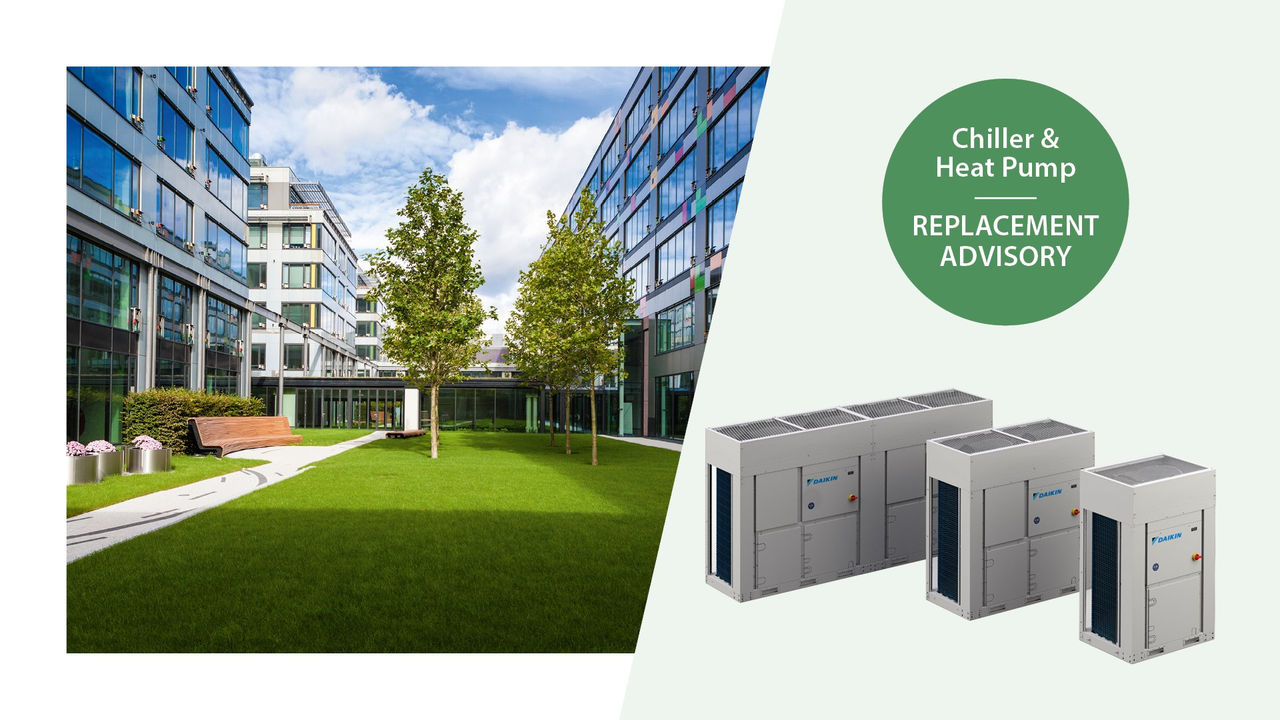
Owners of ageing R-410A equipment should assess replacement now. While existing systems can still operate and be serviced, F-Gas restrictions are changing which new chillers and heat pumps can be placed on the European market, with further restrictions from 1 January 2027. Planning before 2027 keeps more replacement options open, including R-32 alternatives available today.
Here are the key elements of the F-Gas Regulation (EU) 2024/573 and what they may mean for the future cost and availability of R-410A refrigerant:
A chiller or heat pump is a long-term investment in a building’s technical infrastructure. Its replacement therefore involves much more than simply choosing a refrigerant. Waiting until ageing equipment fails can leave considerably less time to analyse actual demand, compare different technologies, establish the project budget and schedule installation around building operations.
Solutions operating on R-32, R-454C and R-290 refrigerants provide different replacement pathways for R-410A units, depending on system capacity, application, required water temperature and site-specific safety requirements. The following provides an overview of their characteristics and considerations for replacement projects:
Existing systems can continue to be operated and serviced in accordance with the applicable F-Gas Regulation requirements, while Daikin aims to provide spare parts and technical support throughout the operational life of the system. The placing-on-the-market restrictions for certain new equipment do not constitute a general ban on the operation of existing systems.
For facility owners evaluating the replacement of a single chiller or heat pump, or managing a broader replacement programme, Daikin recommends beginning with an assessment of the existing installation and actual building demand. Daikin’s Chiller & Heat Pump Replacement Advisor can be used to compare replacement scenarios based on energy-efficiency, refrigerant and financial parameters.
Access Daikin’s Chiller & Heat Pump Replacement Advisor: https://daikin.formstack.com/forms/chiller_hp_replacement_advisor
Reference:
Copyrights pictures: Daikin
About
100+ years Daikin
The story of Daikin has always been shaped by groundbreaking ideas, technological innovations, and dedicated people. It began in 1924 when the young Japanese engineer Akira Yamada founded an enterprise in Osaka to manufacture aircraft radiators with a 15-member team. More than 100 years later, the Daikin Industries group brings future-proof solutions for heating, cooling, ventilation, air purification, and refrigeration (HVAC-R) to global markets.
Read more on 100 Years Daikin
Daikin Industries Ltd.
Daikin Industries is a global leader in heat pump, air conditioning and air filtration technology, employing more than 104,000 people. Founded in Osaka in 1924, it is the only manufacturer in the world that develops and manufactures HVAC-R equipment, compressors and refrigerants in-house. Daikin has been recognized as one of the world’s top 100 innovative companies by Clarivate (UK) and LexisNexis (USA) for its leadership in technology research and intellectual property patents. For its fiscal year 2025 (1 April 2025 – 31 March 2026) Daikin reported a sales result of 28.66 billion euro.
Read more on www.daikin.com
Daikin Europe N.V.
The Daikin Europe group is a leading provider of heating, cooling, ventilation, air purification and refrigeration technology across Europe, the Middle East, and Africa. Daikin Europe caters to a diverse customer base within the region by designing, manufacturing, and marketing an extensive range of products, maintenance services, and turnkey solutions tailored for residential, commercial, and industrial applications. The group employs over 14,200 people across more than 57 subsidiaries and operates 15 manufacturing sites in Europe (12), Turkey (1) and the Middle East (2). Refrigeration products include the brands Daikin, Tewis, Zanotti, Hubbard, and AHT. Headquartered in Ostend, Belgium, for over 50 years, the Daikin Europe group is a subsidiary of Daikin Industries Ltd.
Read more on www.daikin.eu
Daikin Airconditioning Central Europe
Daikin Airconditioning Central Europe, founded in 1999 with its headquarters in Vienna, Austria, operates as a subsidiary of Daikin Europe. Its portfolio includes products and total solutions for heating, cooling, ventilation, air purification, and refrigeration in residential, commercial, and industrial settings. With over 700 employees and 3,400 partners, the company manages sales and service activities across 16 countries in Central and Eastern Europe, including Austria, Albania, Bosnia and Herzegovina, Bulgaria, Croatia, the Czech Republic, Hungary, Kosovo, Montenegro, Moldova, North Macedonia, Poland, Romania, Serbia, Slovakia, and Slovenia.
With 'Your Daikin World' at the Vienna headquarters and the 'Daikin Inspiration Park' in Warsaw, the HVAC-R industry and the construction sector have access to two state-of-the-art B2B-experience centers for co-creating customized solutions for hotels, retail, offices, and large commercial applications. Daikin runs ten out of 146 B2B-training centers across the EMEA region in the CE-region. Consumers and homeowners receive consultation at the B2C-Experience center (flagship store) in Vienna.
Read more on www.daikin-ce.com
Media contact
Doris Passler
Manager Corporate Communications Central Europe
Daikin Airconditioning Central Europe HandelsgmbH
Lemböckgasse 59/1/1, 1230 Vienna, Austria
T: +43 (0) 664 24 56 444
M: passler.d@daikin.at