20 years Daikin Altherma air-to-water heatpumps made in Europe_FINAL
PDF | 926.19KB

Stefanie Debaets, Daikin Europe Project Manager for the development of Daikin Altherma 4 air-to-water heat pump, offers a behind-the-scenes look at heat pump development, from the evolution of air-conditioning technology into heating and the transition from R-410A to R-32 and R-290 refrigerants, to the role of Daikin partners in refining products.
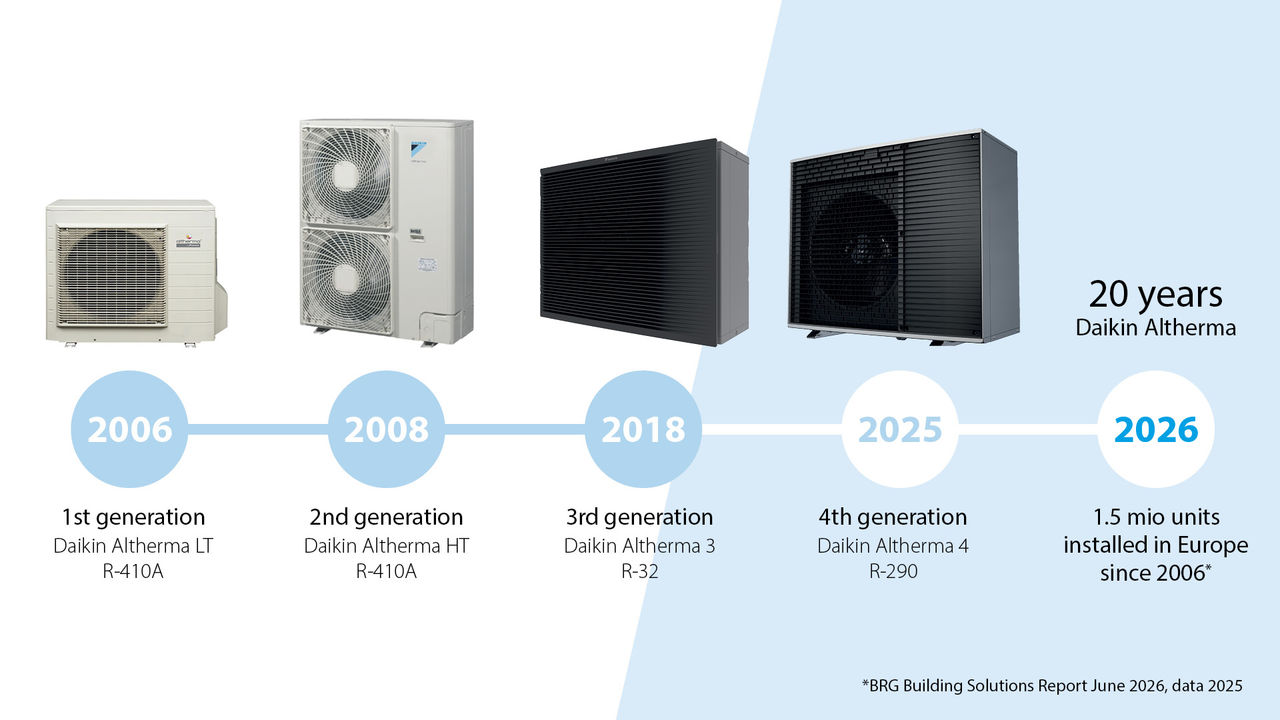
In 2006, Daikin launched the first generation of the Daikin Altherma air-to-water heat pump in Europe. At the time, oil and gas boilers dominated the heating market. Three years later, EU Directive 2009/28/EC formally recognised aerothermal energy, the heat stored in ambient air, as energy from a renewable source. Over the past two decades, the range has evolved through four generations, with more than 1.5 million units installed across Europe.1) This achievement underlines Daikin Altherma’s long-standing presence in Europe’s air-to-water heat pump market and its position as one of the best-selling brands in the segment.
Daikin’s air-to-water heat pump range has its origins in air-conditioning technology.
“We wanted to find out whether the heat pump technology used in our air conditioners could also be used to produce hot water for radiators and underfloor heating systems.”
Stefanie Debaets, Project Manager for the development of Daikin Altherma 4 heating systems at Daikin Europe’s Research & Development Centre (EDC) in Ghent, Belgium
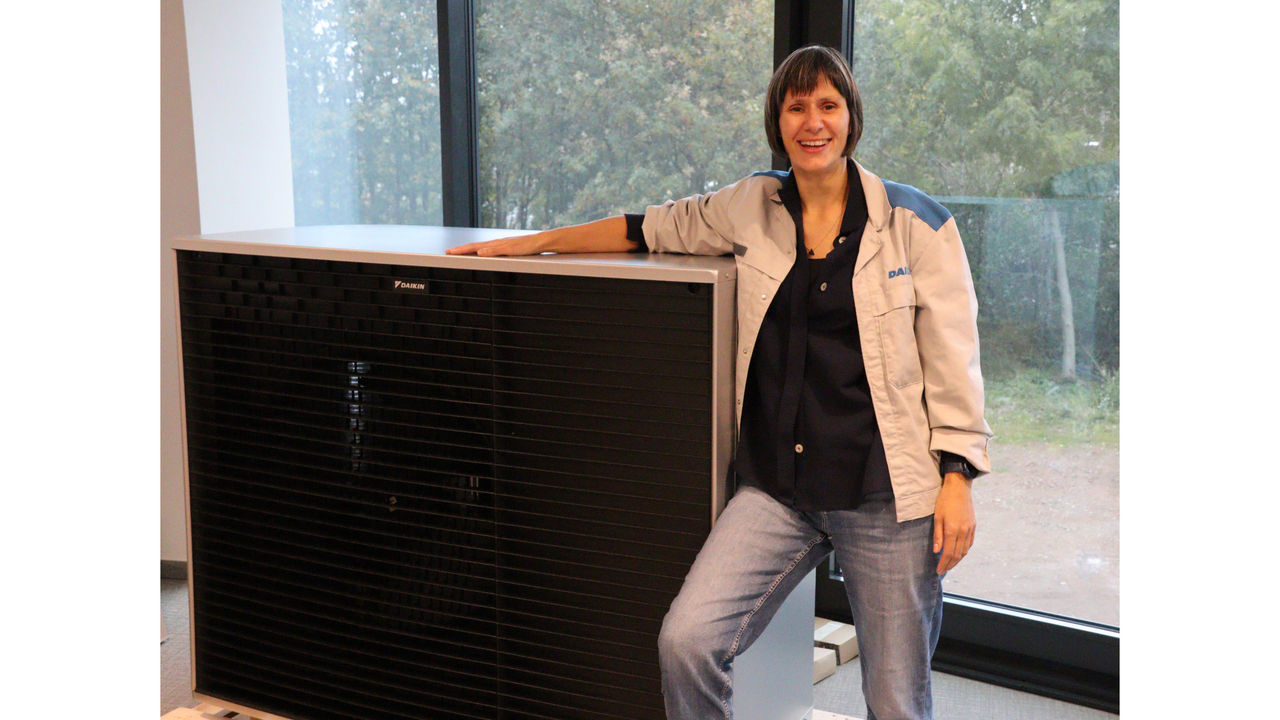 Image: Stefanie Debaets from Daikin Europe has worked on three of the four product generations.
Inspiration also came from the French market, where installers had already begun combining Daikin outdoor units with their own indoor units to create air-to-water heat pump systems. The name Daikin Altherma captures this concept: “All-Thermal” stands for heating, cooling and domestic hot water, while “Alternative Thermal” refers to ambient air as an energy source.
For many installers, air-to-water heat pumps were still new territory in 2006. To demonstrate reliable heating performance even in extreme cold, Daikin conducted a field test in Sweden during the winters of 2005 and 2006, with outdoor temperatures falling as low as minus 25°C. The measurement data was made available online, allowing installers to see the system’s performance under real-world conditions.
“Concerns that a heat pump cannot provide reliable heating in cold weather have diminished considerably over time. Today, customer consultations are more often focused on upfront costs and suitability for existing buildings.”
Stefanie Debaets
 Image: Daikin Altherma outdoor unit from 2006
From the first to the second generation, development focused particularly on performance in colder climates such as Scandinavia. In 2008, the Daikin Altherma HT was introduced as a high-temperature model for replacing fossil-fuel heating systems, followed in 2014 by the Daikin Hybrid heat pump. With the launch of Daikin Altherma 3 in 2018, Daikin transitioned from R-410A to R-32, contributing to higher efficiency and affordability. The third generation also marked a new focus on the design of the indoor unit.
The fourth generation, the Daikin Altherma 4 H, was launched in 2025 with R-290 refrigerant. Designed for existing buildings the 8 to 14 kW capacities achieve leaving water temperatures of up to 75°C in heat pump-only operation at an outdoor temperature of minus 15°C, while the 4, 6 and 7 kW capacities reach up to 70°C at minus 10°C. In many cases, these high-water temperatures allow existing radiators to remain in use.
“The biggest challenge was the compressor. It must handle high pressure ratios and high discharge gas temperatures. To maintain a good coefficient of performance and heating capacity under these conditions, we use gas injection.”
Stefanie Debaets
In night mode, the sound pressure level at a distance of 3 metres is 28 dB(A) for the 4 to 10 kW capacities and 31 dB(A) for the larger capacities. Several design features contribute to these low sound levels, including a sound-optimised front grille and fan mounting, a vibration-damped machine compartment, and a specially developed insulated sound enclosure around the compressor.
The Daikin Altherma 4 H is designed as a hydrosplit system, with outdoor and indoor unit connected by water pipes rather than refrigerant lines.
“This connection can also be installed by professionals without specific refrigeration certification. This means that a significantly larger pool of installers can install these heat pumps.”
Stefanie Debaets
In addition, Daikin has developed dedicated safety components, including an R-290 gas separator, a robust refrigerant container designed for transport and installation, and a sealed PCB box that isolates the electronics from the refrigerant. The Daikin Academy also provides training for installers and service-technicians on the safe handling of R-290.
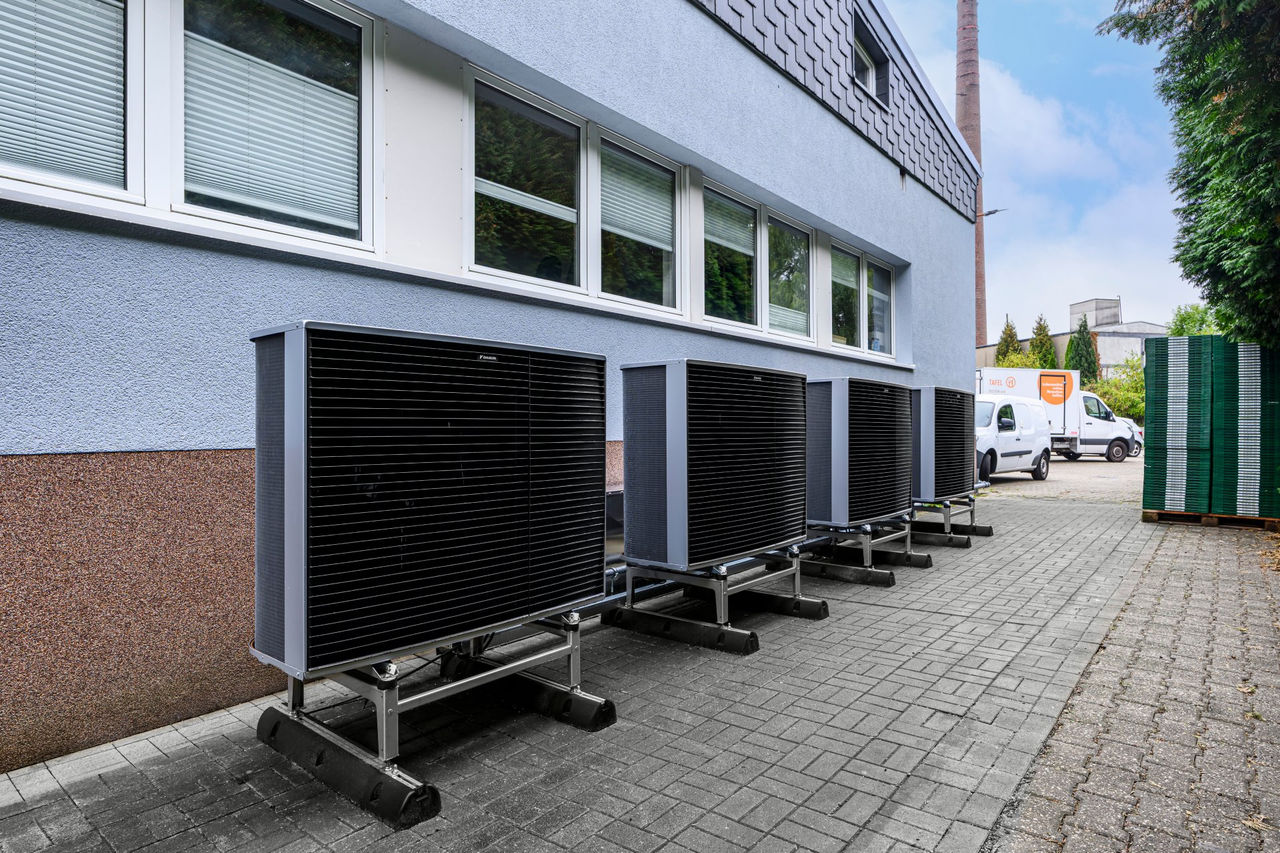 Image: The Daikin Altherma 4 H was specifically designed for existing buildings but is also suitable for new-build applications, from single-family and multi-family homes to commercial buildings. In a cascade configuration, as shown here, it can also serve larger buildings.
 Image: Daikin Altherma 4 H in laboratory testing: In the “Snowroom” at Daikin Europe’s development centre in Ghent, the outdoor unit must withstand conditions including snow, fog and temperatures as low as minus 25°C.
“At Daikin, we follow the Japanese Gemba principle in product development: going to where the work happens. By working closely with installers, we can incorporate their feedback directly into the development process.”
Stefanie Debaets
For the Daikin Altherma 3, installer feedback led to the integration of two carrying loops into the unit’s feet instead of conventional handles, following hands-on testing of the design. With the Daikin Altherma 4, feedback led to a different outcome: an idea for pre-wired power plugs was dropped because installers preferred the flexibility to work according to their own practices. Details like these can make a significant difference to how straightforward a unit is to install.
“Much has evolved since the first Daikin Altherma, from refrigerants to product design. What has not changed are our design principles, high-quality standards and rigorous testing. To this day, we develop and manufacture most components, including the compressors, in-house. And our goals remained the same: reliability, durability, safety and quality.”
Stefanie Debaets
Looking ahead, the role of heat pumps is set to expand beyond heating and cooling. Increasingly, they can become an integral part of home energy management, coordinating energy from PV systems and battery storage with demand for heating, cooling and domestic hot water. By adjusting their electricity consumption in response to grid conditions, heat pumps can also contribute to greater flexibility in the electricity system.
From freezing temperatures and costs to refrigerants: here are factual answers to frequently asked questions about air-to-water heat pumps, along with the relevant facts about the Daikin Altherma 4 H.
Yes. Before launching the first Daikin Altherma, Daikin conducted a field trial in Sweden, testing the system at outdoor temperatures as low as -25°C. The Daikin Altherma 4 H (4th generation) is also tested in the laboratory at our European Research and Development center in Ghent, Belgium, under winter conditions down to minus 25°C, including snow and fog.
The 8 to 14 kW capacities achieve leaving water temperatures of up to 75°C at an outdoor temperature of minus 15°C without the use of the backup heater. The 4, 6 and 7 kW capacities achieve leaving water temperatures of up to 70°C at minus 10°C.
The Daikin Altherma 4 H was specifically developed for existing buildings. With leaving water temperatures of up to 75°C for the 8 to 14 kW capacities and up to 70°C for the 4 to 7 kW capacities, existing radiators can continue to be used in many cases.
Whether this is possible in a specific home can be determined by an installer through a heat load calculation. As a rule, the lower a building’s energy demand, the more efficiently the heat pump operates.
Not necessarily. The high leaving water temperatures of the Daikin Altherma 4 H are designed to allow existing radiators to continue to be used. An installer can determine whether individual radiators need to be added or enlarged based on the building’s heat load and the existing heat emitters.
The current range of Daikin Altherma 3 R MT and Daikin Altherma 4 H offer solutions for new builds and renovations, covering different heating and domestic hot water needs with energy efficiency ratings of up to A+++ for heating and A+ for domestic hot water.
The Daikin Altherma 4 H uses propane (R-290) as its refrigerant with a low Global Warming Potential (GWP) of 0.02. To ensure a high level of safety throughout the entire product lifecycle, Daikin has developed its own safety components, including a particularly robust refrigerant container for transport and installation, a newly developed R-290 gas separator, and a sealed PCB box that consistently separates the electronics from the refrigerant.
With the Daikin Altherma 4 H, all refrigerant remains within the outdoor unit. In this hydrosplit system, the outdoor and indoor units are connected only by water pipes, so under normal operating conditions no refrigerant enters the building.
In night mode, the sound pressure level at a distance of 3 metres ranges from 28 to 31 dB(A), depending on the unit capacity. This is achieved through measures including a sound-optimised fan mounting, a vibration-damped compressor compartment and an insulated soundproof enclosure around the compressor. The actual sound level experienced by neighbours also depends on where the outdoor unit is installed.
 Image: Daikin Altherma 4 H at our sound test room at Daikin Europe Research and Development Center in Ghent, Belgium
While a heat pump can require a higher initial investment than a gas boiler, its high energy efficiency can result in lower annual energy costs. The overall cost advantage over the system's lifetime depends on factors including the building's heat demand, system design, energy prices and available financial support. In several EU countries the energy transition towards heat pumps is supported by subsidies.
One key difference between the two systems is their energy efficiency. Broadly speaking, a gas condensing boiler produces slightly less than 1 kWh of heat from 1 kWh of gas. By contrast, a heat pump can provide around 4 kWh of heat from 1 kWh of electricity. According to the International Energy Agency, heat pumps currently available on the market are three to five times more energy efficient than natural gas boilers.2)
Daikin has been offering Daikin Altherma air-to-water heat pumps since 2006 and has sold 1.5 million units to date1). The Daikin Altherma 4 is already the fourth generation of the Daikin Altherma range. Each new generation undergoes extensive laboratory and field testing. Across Europe, the Daikin Altherma 4 H has already been installed in many thousands of buildings.
More broadly, the adoption of heat pumps across Europe continues to grow. According to the European Heat Pump Association’s market research 2026, almost 30 million heat pumps are used in Europe, and more will be installed to reach carbon neutrality by 2050.3)
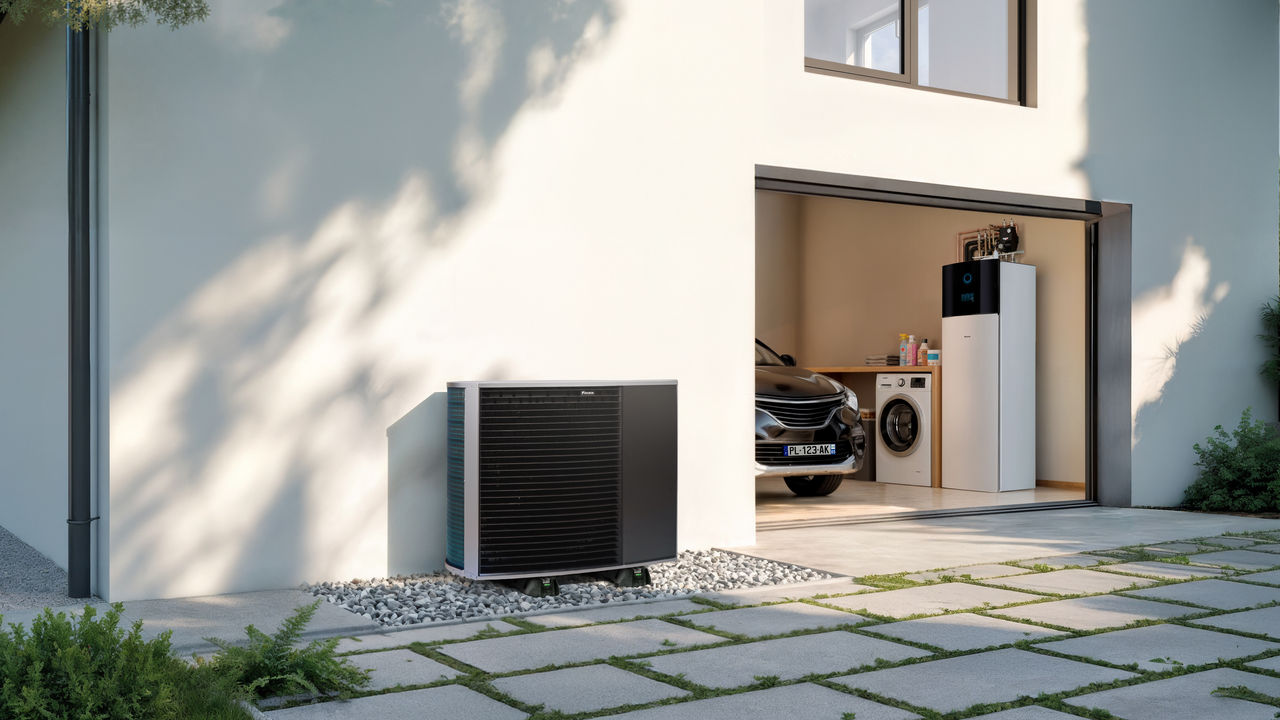 Image: Daikin Altherma 4 outdoor unit installed in a residential home
Yes. The Daikin Altherma 4 H can be controlled via the Daikin Onecta app or directly via the controller. The controller features a 5-inch colour touchscreen with the MMI-4 user interface. Features include custom schedules for heating, cooling and domestic hot water, adjustment of the weather-dependent heating curve, monitoring of operation and energy consumption. Through Daikin Onceta app voice control via Google Assistant and Amazon Alexa is possible.
For installers, the controller provides a dedicated installer menu with extensive configuration options and an integrated commissioning assistant.
2006
Launch of the first generation of Daikin Altherma in Europe
2008
Daikin Altherma HT: high-temperature model for replacing fossil-fuel heating systems
2009
EU recognises ambient heat from the air as a renewable energy source under EU Directive 2009/28/EC
2009
EU Ecolabel for Daikin Altherma LT, making Daikin the first heat pump manufacturer to receive the label
2014
Launch of the Daikin Hybrid heat pump
2018
Daikin Altherma 3: first Daikin residential air-to-water heat pump using R-32
2025
Daikin Altherma 4 H: first Daikin residential heat pump range using R-290
2026
More than 1.5 million Daikin Altherma heat pumps installed in Europe since 2006¹)
Copyrights pictures: Daikin
Reference:
1) Source: BRG Building Solutions, June 2026 report, data April 2025-March 2026
2) Executive Summary - The Future of Heat Pumps - IEA
3) Heat pumps replace Middle East gas imports twice over - European Heat Pump Association (22 June 2026)
About
100+ years Daikin
The story of Daikin has always been shaped by groundbreaking ideas, technological innovations, and dedicated people. It began in 1924 when the young Japanese engineer Akira Yamada founded an enterprise in Osaka to manufacture aircraft radiators with a 15-member team. More than 100 years later, the Daikin Industries group brings future-proof solutions for heating, cooling, ventilation, air purification, and refrigeration (HVAC-R) to global markets.
Read more on 100 Years Daikin
Daikin Industries Ltd.
Daikin Industries is a global leader in heat pump, air conditioning and air filtration technology, employing more than 104,000 people. Founded in Osaka in 1924, it is the only manufacturer in the world that develops and manufactures HVAC-R equipment, compressors and refrigerants in-house. Daikin has been recognized as one of the world’s top 100 innovative companies by Clarivate (UK) and LexisNexis (USA) for its leadership in technology research and intellectual property patents. For its fiscal year 2025 (1 April 2025 – 31 March 2026) Daikin reported a sales result of 28,66 billion euro.
Read more on www.daikin.com
Daikin Europe N.V.
The Daikin Europe group is a leading provider of heating, cooling, ventilation, air purification and refrigeration technology across Europe, the Middle East, and Africa. Daikin Europe caters to a diverse customer base within the region by designing, manufacturing, and marketing an extensive range of products, maintenance services, and turnkey solutions tailored for residential, commercial, and industrial applications. The group employs over 14,200 people across more than 57 subsidiaries and operates 15 manufacturing sites in Europe (12), Turkey (1) and the Middle East (2). Refrigeration products include the brands Daikin, Tewis, Zanotti, Hubbard, and AHT. Headquartered in Ostend, Belgium, for over 50 years, the Daikin Europe group is a subsidiary of Daikin Industries Ltd.
Read more on www.daikin.eu
Daikin Airconditioning Central Europe
Daikin Airconditioning Central Europe, founded in 1999 with its headquarters in Vienna, Austria, operates as a subsidiary of Daikin Europe. Its portfolio includes products and total solutions for heating, cooling, ventilation, air purification, and refrigeration in residential, commercial, and industrial settings. With over 700 employees and 3,400 partners, the company manages sales and service activities across 16 countries in Central and Eastern Europe, including Austria, Albania, Bosnia and Herzegovina, Bulgaria, Croatia, the Czech Republic, Hungary, Kosovo, Montenegro, Moldova, North Macedonia, Poland, Romania, Serbia, Slovakia, and Slovenia.
With 'Your Daikin World' at the Vienna headquarters and the 'Daikin Inspiration Park' in Warsaw, the HVAC-R industry and the construction sector have access to two state-of-the-art B2B-experience centers for co-creating customized solutions for hotels, retail, offices, and large commercial applications. Daikin runs ten out of 146 B2B-training centers across the EMEA region in the CE-region. Consumers and homeowners receive consultation at the B2C-Experience center (flagship store) in Vienna.
Read more on www.daikin-ce.com
Media contact
Doris Passler
Manager Corporate Communications Central Europe
Daikin Airconditioning Central Europe HandelsgmbH
Lemböckgasse 59/1/1, 1230 Vienna, Austria
T: +43 (0) 664 24 56 444
M: passler.d@daikin.at